Yield Generation Using Decentralized Finance

Updated: Oct 5, 2022
There are various ways you can participate in the DeFi ecosystem. DeFi protocols democratize access and allow unprecedented freedom for capital providers to offer financial services. Activities such as market-making, insurance underwriting, and structured product creation were previously only accessible to institutions with a large capital base and specialized knowledge. DeFi has significantly reduced these barriers and availed these activities to the masses. Some of the key areas and activities of DeFi, such as yield farming, liquidity mining, airdrops, and Initial DEX Offerings (IDO) are explained below.
Yield Farming Yield farming is perhaps one of the most innovative features of DeFi. It refers to the activity of allocating capital to DeFi protocols to earn returns. Most DeFi protocolsa re peer-to-peer financial applications where capital allocated is used to provide services to end-users. The fees charged to users are then shared between the capital providersand the protocol. The fees that capital providers get are the intrinsic yield.
In crypto slang, these investors are referred to as “yield farmers” and the yield opportunities as “farms”. Many yield farmers constantly rotate their farms in search of the highest-yielding opportunities.
Below are some examples of yield farming, where the capital provided will be used for a variety of purposes:
● Exchanges - Provide capital for market-making on decentralized exchanges, earning transaction fees in return.
● Lending - Provide loans to borrowers, earning an interest.
● Insurance - Underwrite insurance, earning premiums while undertaking the risk of paying out claims during disasters.
● Options - Underwrite options by selling call and put options to earn a yield.
● Synthetic Assets - Mint stablecoins or other synthetic assets, earning fees in return.
Liquidity Mining
Financial services is a capital-intensive industry and usually benefits from having economies of scale. This means the more capital that firms have, the better. DeFi protocols are no exception - obtaining sizeable capital will be a substantial competitive advantage for DeFi protocols.
In crypto, DeFi protocols incentivize the provision of liquidity via liquidity mining programs. Liquidity mining refers to the reward program of giving out the protocol's native tokens in exchange for capital. These tokens usually come with governance rights and may have the possibility of accruing cash flows from the DeFi protocols.
When designed right,liquidity mining programsare a quick way to bootstrap large sums of liquidity in a short timeframe, albeit with a dilution of token ownership. These programs can also be used to incentivize new users to try out new DeFi protocols. You may think of these incentives similarto how Uber subsidizes ridesin the early days using venture capital.
Liquidity mining programsare also a novel way to attractthe right kind of community participation for DeFi protocols. As DeFi protocolsare open- source in nature, it relies on voluntary contributions from the community. The token distribution encourages community participation in determining the future direction of the protocol.
While it may look like liquidity mining programs offer free rewards by participating, you are locking up your capital for some time, and your capital has an opportunity cost of earning higher returns elsewhere. Additionally, in many instances, locking up your capital is not risk-free. Yield farming activities typically involve various risks that may lead to loss of money.
The most common form of liquidity mining program is the provision of native token liquidity on decentralized exchanges with base tokens such as ETH, WBTC, or USD stablecoins. Such programs incentivize the creation of liquidity surrounding the protocol's native tokens and enable users to trade these tokens on decentralized exchanges easily.
Example
In August 2020, SushiSwap, a decentralized exchange, launched its governance token named SUSHI and wanted to bootstrap the liquidity between SUSHI and ETH. The team offered to reward free SUSHI tokens to anyone that provides liquidity on the SUSHI-ETH trading pair on SushiSwap.
Users will have to provide both SUSHI and ETH in an equal ratio. Let's assume a user has $1,000 worth of ETH and would like to participate in this liquidity mining program to earn SUSHI tokens. The user first exchanges half of his ETH into SUSHI. Then he supplies $500 worth of SUSHI and $500 worth of ETH into the SUSHI-ETH liquidity pool. He will be given SUSHI-ETH Liquidity Provider (LP) tokens, representing his share in the liquidity pool that can then be staked in the SushiSwap platform to obtain the SUSHI token incentive.
Other types of liquidity mining programs have customizable names based on the intended use case of the capital locked. For example, Compound, a decentralized lending and borrowing protocol, gives out COMP tokens to lenders and borrowers to incentivize protocol activity. Nexus Mutual, a decentralized insurance protocol, has a ShieldMining program that gives out NXM tokens to NXM token holders who stake their capital on specific protocols to open up more insurance cover capacity. Hegic, a decentralized options protocol, gives rHEGIC tokensto option sellers and buyers to incentivize protocol activity.
There are several websites to monitor yield farming and liquidity mining opportunities:
Airdrops
Airdrops are essentially freely distributed tokens. Projects usually conduct airdrops as part of their marketing strategy to generate attention and hype around their token launch, albeit with the tradeoff of diluting token ownership.
Some projects also conduct airdrops to reward early users who have interacted with their protocols. Each protocol will have criteria for qualifying airdrop recipients, such as the timing of interaction and minimum amounts used.
Some notable airdrops are shown below:

One of the most notable airdrops was the one conducted by Uniswap. Early users were awarded a minimum of 400 UNI. As of 1 April 2021,the airdrop is worth as much as $11,484.
Introducing UNI - Uniswap. https://uniswap.org/blog/uni/
Initial DEX Offerings (IDO)
Crypto projects have to be creative over their token launch and distribution strategies. With the growing popularity of Decentralized Exchanges (DEX), projects now have a viable option of going direct to users without paying sky-high fees to get listed on centralized exchanges. Crypto project teams can now list their tokens without the need for permission on these DEXs.
However, distributing tokens fairly and to a wide group of users at a fair price is still a difficult endeavor. There are various types of IDOs available, and a few popular types are discussed below.
Initial Bonding Curve Offering (IBCO)
Initial Bonding Curve Offering, or IBCO, is a fairly new concept meant to prevent front-running practices. Essentially, as more investors provide capital into the bonding curve, the token price will increase from its initial value.
However, it does not matter when you choose to contribute since all investors will pay based on the same final settlement price. Based on the price at the end of the IBCO, each investor will receive a portion of the tokens based on their share of the total capitalinvested. Projects such as Hegic and Aavegotchi have used this distribution method in their initial to ken launches with great success.
Liquidity Bootstrapping Pool (LBP)
Hosted using Balancer’s Smart Pools, Liquidity Bootstrapping Pools (LBP) is a way for projects to sell tokens using a configurable Automated Market Maker. Usually, these pools would contain the project token and a collateral token, usually denominated in stablecoins. Controllers of the smartpool can change its parameters and introduce a variety of features to the sale, such as a declining price over time as well as pausing any further swaps due to high demand or external vulnerabilities.
Initial Farm Offering (IFO)
First introduced by PancakeSwap, an Initial Farm Offering (IFO) allows users to stake their Liquidity Provider (LP) tokens in exchange for a project’s tokens. Using an overflow mechanism, users can stake as much or as little as they want. In the event of oversubscription, any excess tokens are returned to the bidder. IFOs on PancakeSwap use the CAKE-BNBLP tokens, where the project receives BNB tokens in exchange for their newly minted protocol’s tokens, while the remaining CAKE tokens are burnt.
Yield Farming: Step-by-Step Guide
In this section, we will be going through a step-by-step guide on yield farming. Using the earlier SUSH/ETH example in here's how to yield farm using Zapper.
Step 1
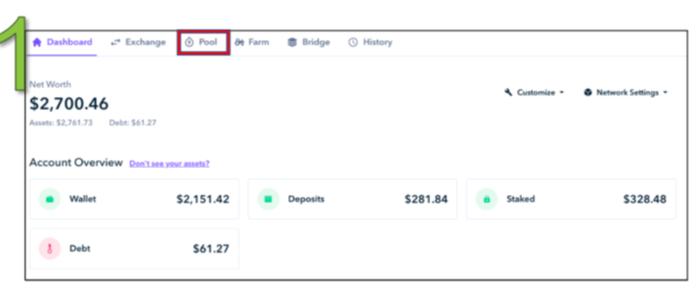
● Connect Ethereum wallet at https://zapper.fi/dashboard
● Select the “Pool” tab

Step 2
● In this guide, we are going to yield farm SUSHI/ETH to get the SUSHI token.
● Click “Invest”

Step 3
● In Zapper, we can swap any single asset to any LP token. Here we will swap ETH to SUSHI/ETH.
● Confirm the transaction.

Step 4
● The SUSHI/ETH position will appear under the Current Investments section.

Step 5
● The “Farm” tab lists yield farming opportunities and their
respective expected returns.
● A green “Stake” button will appear if we have the underlying asset
for the yield farming opportunity.
● Click “Stake”

Step 6
● Approve the transaction. This allows Zapper access to our SUSHI/ETH LP token.

Step 7
● Confirm the transaction.

Step 8
● Now we will be able to earn the trading fees and the liquidity mining reward.
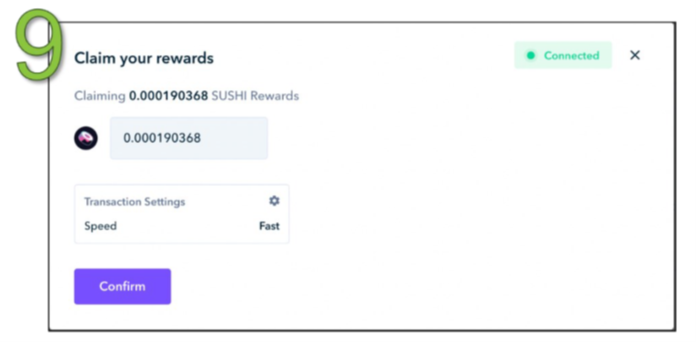
● Click “Claim” to see the rewards.
Step 9
● The rewards can be claimed by clicking “Confirm”.
● We can exit the position by clicking “Unstake”, as shown in the
image at step 8.
Associated Risks
Once you are familiar with the DeFi ecosystem, you will inevitably see various protocols offering eye-popping yields, sometimes more than 1,000% Annual Percentage Yield (APY)! While it is tempting to plow your money in, such APYs are usually temporary and will eventually stabilizeto lower numbers once other yield farmers start coming in.
Given the fast-paced world of DeFi, investors also have to make quick decisions on whether a project is worth investing in. Fear of Missing Out (FOMO) is real and should not be taken lightly.
Regardless of whether you are a trader, investor, or yield farmer, one should always be wary of the usual risks such as smart contract risk, impermanent loss risk, and relevant systemic risk. No matter how technically sound a project may be, liquidity exploits are always possible from malicious actors.
Users need to understand that the DeFi ecosystem is still nascent, and most DeFi activities are still experimental.
Conclusion
DeFi is groundbreaking. We are witnessing a financial revolution happening right in front of us, one which democratizes access to finance, promotes financial inclusion, and promises financial transparency. AlthoughDeFi in its current iteration is not perfect, it does provide us with a glimpse of what the future may look like.
Anyone in the world with access to the Internet can now participate in this grand financial experiment. Cryptofinancial primitives such as being a liquidity provider and the tokenization of ownership allows new forms of organizations to be formed. It will not be long before we see DeFi protocols being more valuable than the largest companies in the world.
Reference
Darren Lau, Daryl Lau, Teh Sze Jin, Kristian Kho, Erina Azmi, Benjamin Hor, Lucius Fang, Khor Win Win, "How to DeFi: Beginner" , May 2021
Recommended Readings
1. Governance Tokens: Investing in the Building Blocks of a New Economy
2. New Models for Utility Tokens https://multicoin.capital/2018/02/13/new-models-utility-tokens/
3. Liquidity Bootstrapping FAQ https://docs.balancer.finance/smart-contracts/smart- pools/liquidity-bootstrapping-faq
4. What is Yield Farming


Comments